


・日本語版(Japanese Ver)
An underwater explorer who investigates and documents environments that are normally difficult to enter: underwater caves, subterranean lakes, shipwrecks, and flooded coal mines.
Through DIVE Explorers, he teaches technical diving designed backward from what exploration and investigation actually demand in the field.


Across Japan, we have investigated and documented the present condition of underwater caves, subterranean lakes, shipwrecks, and submerged mines.
None of these are one-off dives: each is an ongoing project that looks ahead to sharing what we record with researchers, local communities, the media, and everyone else involved.

秋吉台
One of Japan's largest karst plateaus—Akiyoshidai, Yamaguchi Prefecture.
Beneath the limestone lie caves formed over immense spans of time, and the water that flows through them.
In this project, guided by past cave records and terrain data, we have entered the submerged sections and examined their condition.
Placing today's diving investigations alongside the existing records, we are working to read the paths the water takes beneath Akiyoshidai.

軍艦「長良」
The light cruiser Nagara lies off Ushibuka, Amakusa, Kumamoto Prefecture.
Her story has been handed down in the Ushibuka community throughout the postwar years.
This project documents the present state of the hull on the seabed, aiming to leave clues that connect what happened then with what lies there now.
This is not about reaching a wreck: it is about looking again, through the seabed as it is now, at the memorial observances and the memory that Ushibuka has carried on.

南大東島
A remote island far out in the open sea—South Daito Island, Okinawa.
Beneath it stretch unexplored underwater limestone caves and subterranean lakes.
In this project, we have descended into an underwater world that cannot be seen from the surface, investigating, photographing, and documenting its scenery, its life, and its geological features.
We share these records with researchers, connecting the distinctive cave environment beneath the island to scientific understanding.

長生炭鉱
The flooded tunnels of the Chousei Coal Mine lie beneath the sea off Ube City, Yamaguchi Prefecture.
A wartime flooding accident here took many lives.
In this project, we have entered these submerged tunnels, checking conditions inside and facing the traces that remain.
It is an investigation that constantly tests how we engage—not only with diving technique, but with remembrance, with bereaved families, with the local community, and with history.
Project

I lead an exploration and investigation project called JKUEP.
JKUEP stands for Japan Karst & Underwater Exploration Project, and through it we explore and investigate Japan's unexplored underwater caves, submerged mines, shipwrecks, and more.

What exploration should leave behind is more than a personal experience.
Underwater photographs, video, survey data, environmental data, reports.
And delivering them to the researchers, communities, government agencies, media, and others who need them.
Entering the water is only one part of the work.
An explorer's role is to record information that only they can obtain, and to share it with the people who need it.
We welcome inquiries about the investigation, photography, and documentation of underwater caves, shipwrecks, flooded mine tunnels, the submerged sections of karst systems, and other places that are normally difficult to reach.
>> Inquiries about investigations and research


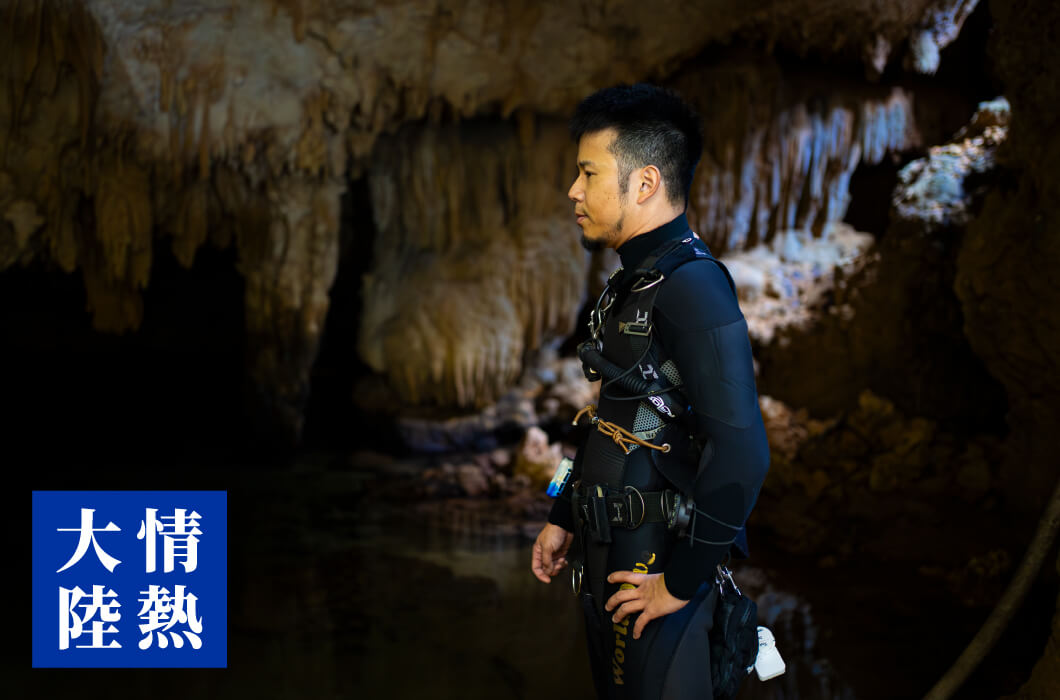
情熱大陸
The documentary series Jounetsu Tairiku profiled underwater explorer Yoshitaka Isaji. The program follows him as he investigates and documents underwater environments that are normally difficult to enter: underwater caves, shipwrecks, flooded coal mines, and groundwater systems.

NHK サイエンスZERO
Science ZERO turned its spotlight on the science of South Daito Island, developing our past investigations into deeper research for an educational science program.

NHK スペシャル
NHK Special featured the exploration of South Daito Island's underwater limestone caves and the investigation of new species by a team of explorers from around the world, led by Yoshitaka Isaji.
Underwater filming was conducted mainly with 8K cameras, and the project also used cutting-edge techniques such as photogrammetry of the caves themselves.

NHK フロンティア
The NHK BS program "Frontier" featured the investigation and exploration of the beautiful underwater limestone caves beneath the remote Okinawan island of South Daito.

NNNドキュメント
The NNN Document program "Aboji ga Nemuru Umi" (The Sea Where Father Sleeps) covered our work on the underwater investigation of the Chousei Coal Mine.

報道特集
The TBS program Hodo Tokushu reported on Yoshitaka Isaji's work as an underwater explorer and technical diving instructor, including the underwater investigation of the Chousei Coal Mine.
News / Feature Programs, etc.
For Media
>> Inquiries for interviews, program production, radio, and lectures

Underwater exploration and investigation are never the work of a single diver.
Equipment, gas, boats, photography, surveying, local coordination, record-keeping, report writing.
Every one of these takes a great deal of preparation and support.
Our investigation and documentation work is made possible by the companies and organizations that back us through sponsorship and official support,
and by the individuals who stand behind us over the long term through note, crowdfunding, and more.
Sponsor (A→Z)

Ookini Shoten

Oceanus
Operational Support (A→Z)
BORODINO DIVE
※ South Daito Island Underwater Cave Exploration Project

VOX plus
※ Chousei Coal Mine / Akiyoshidai Projects
Official Support (A→Z)

FM Okinawa
※ South Daito Island Underwater Cave Exploration Project

FMY FM Yamaguchi
※ Akiyoshidai Underwater Investigation Project

KRY Yamaguchi Broadcasting
※ Akiyoshidai Underwater Investigation Project

OTV Okinawa Television Broadcasting
※ South Daito Island Underwater Cave Exploration Project

ROK Radio Okinawa
※ South Daito Island Underwater Cave Exploration Project

Ryukyu Broadcasting Corporation (RBC)
※ South Daito Island Underwater Cave Exploration Project

tys TV Yamaguchi
※ Akiyoshidai Underwater Investigation Project

yab Yamaguchi Asahi Broadcasting
※ Akiyoshidai Underwater Investigation Project

Readers back our work month after month
through the monthly note magazine (Japanese).


The wish to reach places where no one has yet set foot is, to my mind, one of the most fundamental impulses humanity has carried.
Perhaps it was this same pull toward the unknown that lay behind humankind's spread across the world from its origins in Africa.
I believe that taking on the unexplored while tempering that desire with reason gradually extends the range of human knowledge and activity.

The records gained through underwater exploration are not meant to end as one person's experience.
Curiosity is where exploration begins—but exploration takes on social meaning only when its records reach the people who need them: researchers, local communities, the media, government agencies, and others involved.
The discovery of new species at great depth, the investigation of groundwater systems, rescue operations in overhead environments—there is no end to the places that cannot be reached without advanced skill and knowledge, yet are still worth investigating.

Underwater exploration is never accomplished alone.
A single project takes local coordination, equipment preparation, gas planning, photography, surveying, safety management, record-keeping—a great deal of preparation, and the strength of a team.
Not by courage, but by skill and preparation: reach the site, investigate, document, and return to the team. That is underwater exploration as I understand it.

Drawing on the experience gained through past explorations and the network formed through each project, I provide technical diving courses and guiding.
At DIVE Explorers, training is built around investigation and documentation—in underwater caves, on shipwrecks, at great depth, and in other complex environments.
Whether you want to build practical technical diving skills, hope one day to join our projects, or wish to dive the sites an underwater explorer has opened up—we look forward to hearing from you.


